
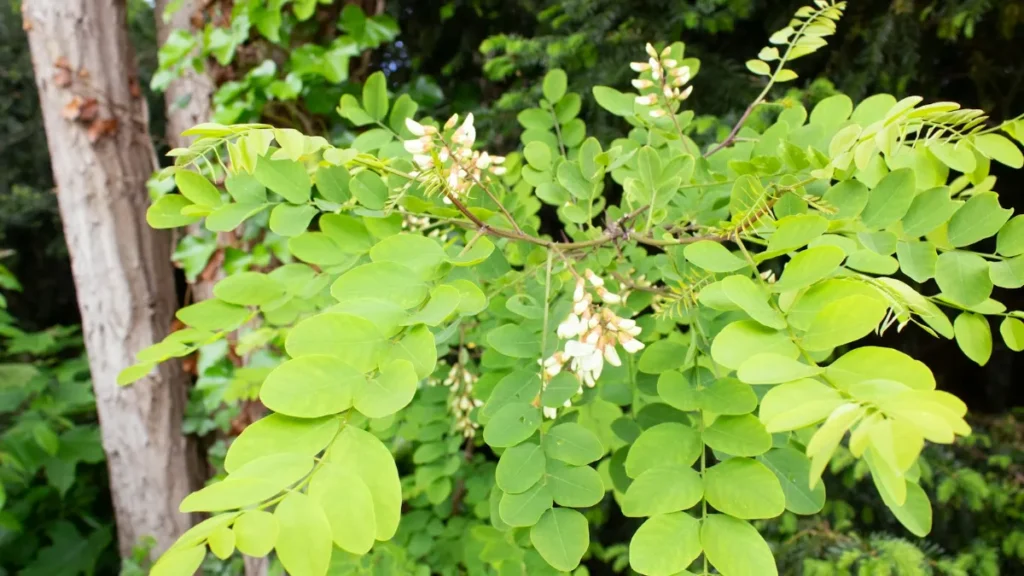
“Locust” usually means one of two North American trees: black locust and honey locust. Both are tough and fast-growing, and both can carry vicious thorns. Black locust has a bigger problem: cut it down and it sends up sprouts from its roots, often turning one tree into a thicket.
This guide explains how to tell the locusts apart, the problems each causes, how to stop a locust from coming back, and what locust tree removal costs in 2026.
Black Locust vs. Honey Locust
| Locust | Typical height | Thorns | Key notes |
|---|---|---|---|
| Black locust (Robinia pseudoacacia) | Up to 75–82 ft | Paired spines up to 1 in. at leaf bases, longer on sprouts | Root-sprouting; invasive in many states; toxic bark, seeds and leaves |
| Honey locust (Gleditsia triacanthos) | Up to about 60 ft | Large, often branched spines on trunk and limbs (wild trees) | Thornless, seedless forms common in cities |
Black Locust
The USDA Forest Service says black locust is native “from Pennsylvania through the Appalachians to northern Georgia,” west to Arkansas and Oklahoma, and may reach about 82 feet. Its wood is hard and durable and often used for fence posts. University of Minnesota Extension describes it as a fast-growing tree “up to 75 feet tall with an open crown,” whose seedlings and root sprouts have “noticeably long thorns.”
Honey Locust
The Missouri Department of Conservation lists honey locust at up to about 60 feet, with “heavy, simple or branching spines” on wild trees that can reach about a foot long on twigs. Its fruit is a dark brown, twisting pod 6 to 18 inches long. MDC notes that “thornless and seedless varieties” are popular for landscaping and city streets.
Common Locust Tree Problems
Root Sprouts and Invasive Spread (Black Locust)
The USDA Forest Service says black locust often becomes invasive because of heavy seed production and “prolific root sprouts.” UMN Extension says it spreads by root suckering and runners, “crowds out native vegetation” in prairies, savannas and forests, and is a restricted noxious weed in Minnesota. Washington State lists it as a Class C noxious weed.
Thorns
Wild honey locusts and black locust sprouts have sharp thorns that can puncture skin, shoes and even tires. They make pruning, mowing and removal slower and riskier.
Toxicity
Washington State University warns: “The bark, seeds, and leaves of black locust trees are toxic.” Symptoms range from stomach upset to nervous system problems, and anyone (or any animal) that eats them needs medical or veterinary care right away. Keep children and livestock away from black locust.
Pod Litter (Honey Locust)
Seed-bearing honey locusts drop long pods in fall and winter, which can litter lawns and drives. Seedless cultivars avoid this.
How to Stop a Black Locust From Coming Back
Cutting alone rarely works. WSU says “Cutting trees alone is ineffective in the long term because plants resprout from roots.” Options:
- Cut-stump treatment: WSU says applying triclopyr to a freshly cut stump, following the label, can give good control.
- Repeated cutting: cutting sprouts again and again can eventually exhaust the roots, but it takes several years.
- Grinding: grind the stump and keep cutting any sprouts that appear.
WSU adds that homeowners should not spray trees over 10 feet tall and that mature trees usually call for a certified arborist. See how to kill a tree stump and the stump removal cost calculator.
Should You Remove a Locust Tree?
Keep it if it is a healthy, thornless honey locust giving light shade, or a black locust well away from lawns and pastures.
Consider removal if:
- Thorny trees or sprouts are in play areas, paths or pastures.
- Black locust is spreading into lawns, gardens or natural areas.
- Livestock or pets could eat bark, seeds or leaves.
- The tree is dead, storm-damaged or leaning over buildings; see dead tree removal cost.
How Much Does Locust Tree Removal Cost?
Locust trees are usually 30 to 80 feet tall. Lawn Love’s 2026 averages by height:
| Locust tree size | Typical removal cost (2026) |
|---|---|
| Up to 30 ft | $285 – $435 |
| 30–60 ft | $435 – $870 |
| 60–80 ft | $870 – $1,160 |
| Stump removal (added cost) | $180 – $525 |
National averages; local prices vary.
What affects the price:
- Thorns. Thorny trees take longer to climb, cut and chip safely.
- Dense, heavy wood. Locust wood is hard, which adds to cutting time; ask whether the crew will leave it as firewood.
- Sprout control. Budget for stump treatment or grinding and follow-up sprout cutting, or the tree may return.
- Several trees. Clearing a locust thicket is often priced as land clearing; see tree and bush removal.
Get a quick figure from the tree removal cost calculator or compare species with the cost by size and type calculator. Browse other species in the tree species guide.
Frequently Asked Questions
What is the difference between black locust and honey locust?
Black locust has paired short spines at the leaf bases and spreads aggressively by root sprouts. Honey locust has long, often branched thorns on the trunk (wild trees), and long twisting pods. Thornless honey locusts are common street trees.
Is black locust invasive?
Outside its native range (the Appalachians west to Arkansas and Oklahoma), often yes. It is a restricted noxious weed in Minnesota and a Class C noxious weed in Washington.
Why does black locust keep growing back after cutting?
It resprouts from its roots. Washington State University says cutting alone is ineffective long term; treating the fresh stump with a labeled herbicide or repeatedly cutting sprouts is needed.
Is black locust poisonous?
Yes. Washington State University says the bark, seeds and leaves are toxic to people and animals if eaten.
How much does it cost to remove a locust tree?
Most locust removals cost about $435 to $1,160 depending on height, plus $180 to $525 for the stump, based on Lawn Love’s 2026 national figures.
Sources: USDA Forest Service, Black Locust (Robinia pseudoacacia) · University of Minnesota Extension, Black Locust · Washington State University HortSense, Weeds: Black Locust · Missouri Department of Conservation, Honey Locust · Lawn Love, How Much Does Tree Removal Cost? (2026)
Last updated: November 20, 2026.