
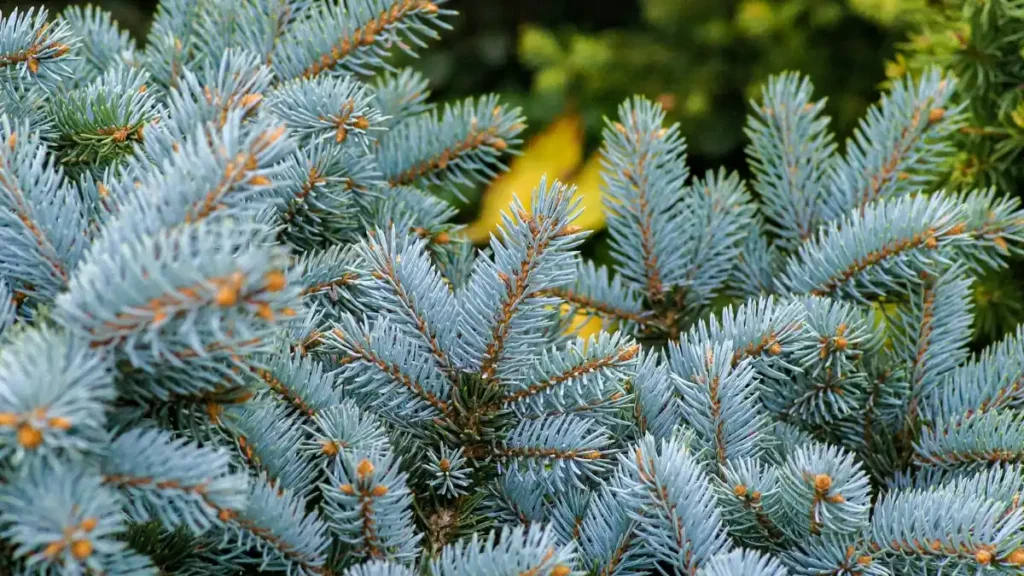
Spruce trees are among the most planted evergreens in North America, especially Colorado blue spruce. But many homeowners notice the same thing after 15 or 20 years: the lower branches turn purple-brown, drop their needles and die, and the problem climbs the tree each year.
This guide explains the common types of spruce, the two diseases behind most dying spruces, when a spruce can be saved and what spruce tree removal costs in 2026.
Common Types of Spruce Trees
| Spruce | Typical mature size | Key notes |
|---|---|---|
| Colorado blue spruce (Picea pungens) | 30–60 ft tall, 10–20 ft wide | Native to the Rockies; very prone to needle cast |
| Norway spruce (Picea abies) | 40–60 ft tall, 25–30 ft wide | European; fast-growing; drooping branchlets |
| White spruce (Picea glauca) | 40–60 ft tall, 10–20 ft wide | Native to Canada and the northern U.S.; tough |
Sizes from NC State Extension (linked below).
Colorado Blue Spruce
NC State Extension says Colorado spruce “grows 30 to 60 feet tall, spreading 10 to 20 feet wide,” and is native to the central Rocky Mountains. The University of Minnesota calls it “one of the most widely planted trees in the urban environment,” but “susceptible to Rhizosphaera needlecast.”
Norway Spruce
NC State Extension lists Norway spruce at 40 to 60 feet tall and 25 to 30 feet wide, “rapidly growing,” with a shallow root system. It “does poorly in zone 7 in the southern United States.” Utah State University Extension notes that spruce ips beetles are killing many planted Norway spruces there, made worse by under-watering.
White Spruce
NC State Extension lists white spruce at 40 to 60 feet tall and 10 to 20 feet wide, native to Canada and the northern U.S., and among the most tolerant spruces of wind, heat, cold and drought.
Why Are the Lower Branches of My Spruce Dying?
Rhizosphaera Needle Cast
University of Maryland Extension describes the classic pattern: first-year needles on lower branches yellow in midsummer, then turn brown or purplish-brown and drop in late summer or fall. The disease moves up and around the tree, and branches die after 3 to 4 years of repeated needle loss. With a hand lens you can see rows of tiny black dots on the needles.
The Morton Arboretum says “Colorado blue spruce is particularly susceptible and can be severely damaged by this disease,” while Norway spruce is relatively resistant. Trees are rarely killed outright but can be stripped to just the current year’s needles.
Cytospora Canker
The Morton Arboretum calls Cytospora canker “the most prevalent and destructive fungal disease of Norway and Colorado blue spruce.” Signs:
- Lower branches turning purplish, then brown, and dying, usually on trees older than 15 to 20 years.
- White, crusty resin on the bark or running down the trunk.
- Dieback moving up the tree over several years.
UMD says the fungus enters through wounds from pruning, insects, hail or ice, and drought-stressed trees are more vulnerable.
Stress and the Wrong Climate
Both diseases hit stressed trees hardest. UMD notes blue spruce is poorly suited to hot, humid climates such as the mid-Atlantic, and Morton says trees outside their natural range are more prone to Cytospora.
Can a Dying Spruce Be Saved?
It depends on how far the damage has gone. Morton Arboretum and UMD advice:
- Water deeply in dry spells and before winter, and mulch the root zone.
- Prune out dead branches in dry weather, and disinfect tools between cuts.
- Improve air flow and remove fallen infected needles.
- Don’t count on sprays. Morton says chemical control is not useful for Cytospora, and UMD says “fungicide sprays are impractical” for most home trees.
Dead lower branches will not grow back. UMD recommends removing severely diseased trees, since infected branches keep releasing spores for years, and replacing them with better-adapted evergreens. Our guide on when to remove a tree instead of treating it can help.
How Much Does Spruce Tree Removal Cost?
HomeGuide lists $400 to $3,000 to remove a spruce, with typical heights of 50 to 200 feet (most yard spruces are 30 to 60 feet). By height, Lawn Love’s 2026 averages are:
| Spruce tree size | Typical removal cost (2026) |
|---|---|
| Up to 30 ft | $285 – $435 |
| 30–60 ft | $435 – $870 |
| 60–80 ft | $870 – $1,160 |
| Over 80 ft | $1,160 – $2,000 |
| Stump removal (added cost) | $180 – $525 |
National averages; local prices vary.
What affects the price:
- Dense branches. Spruces have many branches all the way down, which means a lot of chipping and hauling. See cost to haul away tree branches.
- Location. Spruces planted close to houses as windbreaks or foundation plantings need sectional removal.
- Rows. Windbreak rows may get a per-tree discount.
- Stumps. Grind the stump if you are replanting; price it with the stump removal cost calculator.
Measure your tree with the tree height calculator, then get a figure from the tree removal cost calculator or the cost by size and type calculator. For other conifers, see our pine tree removal cost and cedar tree guides, or browse the tree species guide.
Frequently Asked Questions
Why is my blue spruce turning purple and losing needles?
The most common cause is Rhizosphaera needle cast, which turns needles purplish-brown starting on lower branches. Cytospora canker, which causes white resin on the bark, is the other common cause.
Will dead spruce branches grow back?
No. Once a branch has lost all its needles, it will not regrow them. Prune dead branches in dry weather.
Can I spray my spruce to save it?
Fungicides are impractical for most home trees, according to University of Maryland Extension, and chemical control is not useful for Cytospora canker, according to the Morton Arboretum. Good watering and pruning help more.
How tall do spruce trees get?
Blue spruce usually reaches 30 to 60 feet, and Norway and white spruce 40 to 60 feet, according to NC State Extension.
How much does it cost to remove a spruce tree?
HomeGuide lists $400 to $3,000. Most yard spruces fall in Lawn Love’s $435 to $870 band for 30- to 60-foot trees, plus $180 to $525 for the stump.
Sources: NC State Extension, Picea pungens (Colorado Spruce) · NC State Extension, Picea abies (Norway Spruce) · NC State Extension, Picea glauca (White Spruce) · University of Minnesota, Blue Spruce · Utah State University Extension, Norway Spruce · University of Maryland Extension, What’s Wrong With My Colorado Blue Spruce? · The Morton Arboretum, Spruce Diseases · HomeGuide, Tree Removal Cost · Lawn Love, How Much Does Tree Removal Cost? (2026)
Last updated: November 20, 2026.