
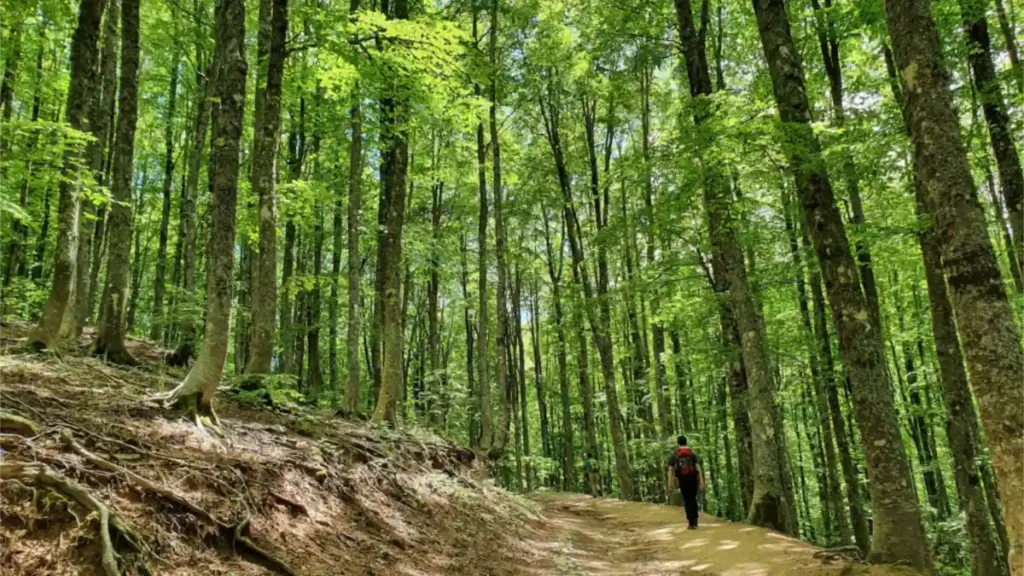
Beech trees are known for their smooth gray bark, dense shade and long life. But two diseases now threaten them across the eastern U.S. Beech leaf disease, first found in 2012, is spreading fast and killing trees, and beech bark disease has weakened beech forests for decades.
This guide covers what to know about beech trees, how to spot both diseases, your treatment options, and what beech tree removal costs in 2026.
About American Beech
NC State Extension lists American beech (Fagus grandifolia) at 60 to 80 feet tall or more and 40 to 80 feet wide, native to eastern North America from Maine to Florida and west to Texas and Minnesota. Key features:
- Smooth, thin, gray bark that stays smooth as the tree ages.
- A vast system of surface roots that sends up suckers; NC State notes whole groves often grow from one tree’s roots.
- Intolerance of wet or compacted soil, so avoid driving or building over its root zone.
European beech, including copper and purple-leaf beech, is widely planted in landscapes and is also affected by beech leaf disease.
Beech Leaf Disease
Beech leaf disease (BLD) is caused by a microscopic nematode, Litylenchus crenatae ssp. mccannii, that lives in leaves and buds, explains Penn State Extension. The University of Massachusetts says it was first found in northeastern Ohio in 2012 and is now widespread in Connecticut, Rhode Island and Massachusetts, spreading north through Maine, New Hampshire and Vermont.
Signs of Beech Leaf Disease
- Dark green bands between the leaf veins, visible in early spring.
- Thick, leathery, cupped or crinkled leaves.
- Early leaf drop and thin canopies.
- Dead buds and branch dieback.
UMass says trees in southern New England are dying quickly after infection, and drought, winter injury and other stresses speed decline. Penn State warns that “repeated damage will kill infected beech.”
Can Beech Leaf Disease Be Treated?
For valuable yard and street trees, Penn State says trunk injections of thiabendazole (Arbotect 20-S) or soil-applied potassium phosphite can help, though both are costly and research is ongoing. There is no practical treatment for forests. Hire a certified arborist to diagnose and treat, and start before the canopy is badly thinned.
Beech Bark Disease
Beech bark disease starts when a scale insect feeds on the bark and opens wounds that a Nectria fungus invades. Penn State Extension lists the signs:
- White, woolly specks on the bark (the scale insects).
- Round to oval cankers and cracked bark.
- Small red fruiting bodies in the cankers.
When large areas are cankered, the tree is girdled and dies. Penn State advises controlling the scale, since “There is no control of the fungus.” Weakened trunks can break in storms, so have an arborist check large infected beech near buildings.
Should You Remove a Beech Tree?
Treat and keep it if BLD symptoms are mild, the tree is valuable, and you are willing to pay for ongoing treatment.
Consider removal if:
- Most of the canopy is thin, with many dead buds and branches.
- The trunk is heavily cankered, cracked or decayed.
- The tree is dead or dying near the house, a driveway or a play area. See dead tree removal cost.
Dead trees become brittle, so it is safer and often cheaper to remove a dying tree before it is fully dead. See when to remove a tree instead of treating it.
How Much Does Beech Tree Removal Cost?
Mature beech trees are usually 60 to 80 feet tall with very wide crowns. Lawn Love’s 2026 averages by height:
| Beech tree size | Typical removal cost (2026) |
|---|---|
| Up to 30 ft | $285 – $435 |
| 30–60 ft | $435 – $870 |
| 60–80 ft | $870 – $1,160 |
| Over 80 ft | $1,160 – $2,000 |
| Stump removal (added cost) | $180 – $525 |
National averages; local prices vary.
What affects the price:
- Wide crown. A 40- to 80-foot spread means many large limbs to lower over yards and roofs. See large tree removal cost.
- Dead or diseased wood. Brittle trees need careful rigging and sometimes a bucket truck or crane; see crane tree removal cost.
- Surface roots and suckers. Grinding the stump and main surface roots stops most suckers; price it with the stump removal cost calculator.
- Treatment vs. removal. Compare the cost of several years of BLD treatment with one-time removal and replanting.
Get a quick figure from the tree removal cost calculator or the cost by size and type calculator. Browse other species in the tree species guide.
Frequently Asked Questions
What does beech leaf disease look like?
Dark green bands between the leaf veins, often with thick, leathery or curled leaves, early leaf drop and dead buds. It shows up in early spring.
Can beech leaf disease kill a tree?
Yes. Penn State says repeated damage will kill infected beech, and UMass reports trees in southern New England are dying quickly after infection.
Is there a treatment for beech leaf disease?
For yard trees, trunk injections of thiabendazole or soil applications of potassium phosphite can help, according to Penn State Extension. Both are costly and need a professional.
What is beech bark disease?
A disease complex where scale insects wound the bark and a fungus invades, forming cankers that can girdle and kill the tree. Look for white woolly specks and red fruiting bodies on the bark.
How much does it cost to remove a beech tree?
Most mature beech trees cost about $870 to $1,160 to remove (60 to 80 feet tall), plus $180 to $525 for stump removal, based on Lawn Love’s 2026 national averages.
Sources: NC State Extension, Fagus grandifolia (American Beech) · Penn State Extension, Beech Leaf Disease · Penn State Extension, Beech Diseases · University of Massachusetts, Beech Leaf Disease · Lawn Love, How Much Does Tree Removal Cost? (2026)
Last updated: November 20, 2026.