
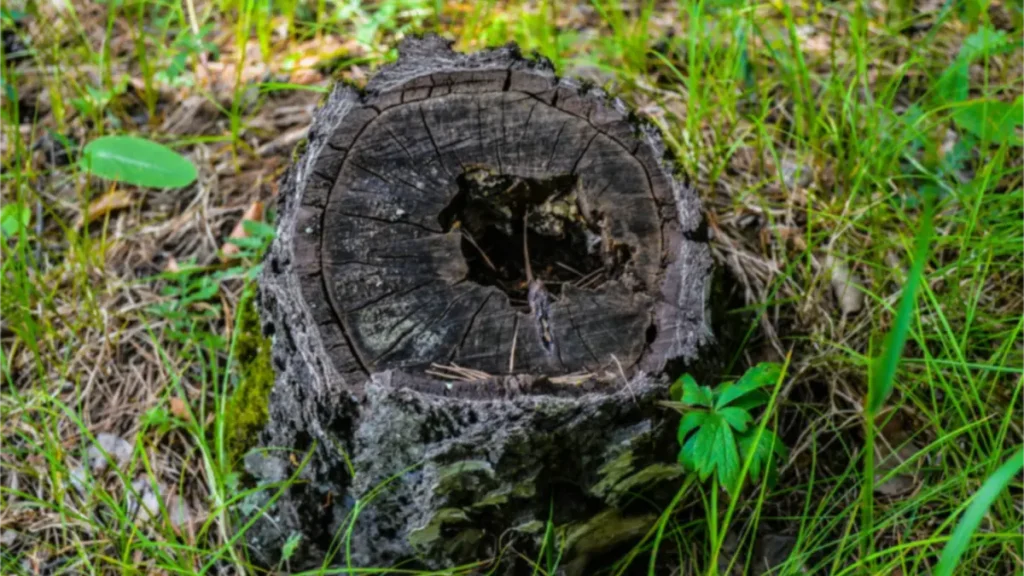
Yes, you can leave a tree stump in the ground. Nothing requires you to remove it, and extension experts point out that a stump left to rot returns nutrients to the soil and gives food and shelter to wildlife. But a stump can also sprout new shoots, take a decade or more to disappear, get in the way of mowing and replanting, and, in a few cases, cause real problems.
This guide covers what happens if you leave a tree stump, the risks worth checking, when removal makes sense, and what stump removal costs in 2026.
What Happens If You Leave a Tree Stump?
It Rots Slowly
Iowa State University Extension says natural decay “can take 10+ years,” depending on soil moisture, wood-decay fungi and the tree species. Rot is caused by fungi, which Oklahoma State University Extension describes as organisms that feed on sources such as wood stumps. Mushrooms around an old stump are usually a sign that this is happening.
It May Sprout
Iowa State notes that “some stumps will resprout after the tree is cut down.” Shoots can come from the stump or the roots. Oklahoma State adds that sprouting can slow the rotting process. Our locust tree guide covers one species well known for root sprouts.
It Becomes Wildlife Habitat
Both Iowa State and Oklahoma State note that insect larvae in the soft wood attract birds, and Iowa State says hollow stumps can shelter owls and squirrels. Some homeowners turn tall stumps into planters or garden features for this reason.
Risks of Leaving a Stump
Termites and Other Insects
A rotting stump attracts wood-feeding insects, including termites. In an Ask Extension answer about a rotting oak stump in a yard, the expert said termites living in the stump should not threaten the house. The bigger risk is wood close to or under the building: Mississippi State University Extension lists “Wooden debris or stumps left in crawl space under building” and trees growing so close that roots reach under the foundation as termite risk factors. If a stump sits right against your home, removal is the safer choice.
Disease
If the tree died from a serious disease, Oklahoma State recommends removing the stump promptly to limit the spread and not planting a new tree in the same spot. The Royal Horticultural Society gives similar advice for soil-borne diseases: remove the tree, its stump and large roots.
Trip Hazards and Mowing
A low stump in a lawn is easy to trip over and hard to mow around. Mower blades and string trimmers also damage themselves on hidden stumps.
Falling or Breaking Apart
Tall stumps left as features should be checked regularly. Iowa State advises removing them if they become a risk of falling.
Replanting and Building
You can’t put a new tree, garden bed, patio or shed in the same spot until the stump is gone.
When It’s Fine to Leave a Stump
Leaving a stump is reasonable when:
- It is away from the house, driveway and play areas.
- The tree was healthy, not killed by a soil-borne disease.
- It isn’t sending up sprouts, or you are willing to cut them.
- You don’t need the space for replanting or building.
When to Remove It
Remove the stump if:
- It is close to the foundation, a crawl space or a deck.
- The tree died of a disease that can spread through soil or roots.
- It keeps resprouting.
- It is a trip hazard or blocks mowing.
- You want to replant, landscape or build in that spot.
See our guide to the best time of year to remove a tree stump.
How to Stop a Stump From Growing Back
Iowa State says herbicides containing glyphosate, triclopyr or imazapyr can reduce resprouting when applied to the living tissue just under the bark. Oklahoma State recommends applying an appropriate herbicide to the freshly cut stump within 24 hours. Cut new sprouts and reapply until they stop. Iowa State advises avoiding products that contain picloram (Tordon), and warns that herbicides don’t speed decay. Always follow the product label. For more detail, see how to kill a tree stump.
How to Speed Up Natural Decay
If you prefer to let the stump rot, Iowa State suggests cutting it low, drilling one-inch holes at least 10 inches deep and no more than 12 inches apart, and filling them with slow-release fertilizer. With this method, a stump can usually be broken up with a sharp spade after one to three years.
Both universities warn against burning stumps. Iowa State says stump fires “can burn for days and are difficult to control and extinguish,” and Oklahoma State notes that local rules may restrict burning.
How Much Does Stump Removal Cost?
If you decide the stump has to go, grinding is the quickest and safest option, according to Iowa State. A grinder removes the stump and large surface roots, typically 8 to 12 inches deep. Lawn Love’s 2026 averages:
| Service | Typical cost (2026) |
|---|---|
| Stump grinding | $120 – $210 |
| Per diameter inch | $2 – $5 |
| Minimum fee (most companies) | About $100 |
| Full stump removal, roots included | $180 – $525 |
National averages from Lawn Love and its stump removal guide. Local prices vary.
What affects the price:
- Diameter. Most companies price by the inch across the stump.
- Number of stumps. Additional stumps on the same visit usually cost less each.
- Access. Stumps behind fences or on slopes take longer.
- Cleanup. Iowa State notes that filling the hole and removing the wood shavings often cost extra.
Get a quick figure with the stump removal cost calculator, and see what happens to roots after stump grinding.
Frequently Asked Questions
Is it okay to leave a tree stump in the ground?
Yes, in most cases. A stump away from buildings, from a healthy tree, can be left to rot and gives food and shelter to wildlife. Remove it if it is near the foundation, keeps sprouting or came from a diseased tree.
Will a tree stump grow back?
Some stumps resprout after the tree is cut down. Iowa State Extension says herbicides containing glyphosate, triclopyr or imazapyr, applied to the living tissue under the bark, can reduce resprouting.
How long does it take for a tree stump to rot?
Iowa State Extension says natural decay can take 10 or more years. Drilling holes and adding slow-release fertilizer can make the stump easy to break up in one to three years.
Do tree stumps attract termites?
Rotting stumps can host termites and other wood-feeding insects. Stumps away from the house are generally not a threat, but stumps or wood debris near or under the building are a termite risk factor, according to Mississippi State University Extension.
How much does it cost to grind a stump?
Stump grinding typically costs $120 to $210, or about $2 to $5 per diameter inch, with a minimum fee around $100, based on Lawn Love’s 2026 national averages.
Sources: Iowa State University Extension, How to Remove Tree Stumps · Oklahoma State University Extension, Stump Removal · Ask Extension, Tree Stump Decay · Mississippi State University Extension, Conducive Conditions: Common Termite Risk Factors · Royal Horticultural Society, Removing Trees and Stumps · Lawn Love, How Much Does Stump Grinding Cost in 2026? · Lawn Love, How Much Does Stump Removal Cost in 2026?
Last updated: November 20, 2026.