
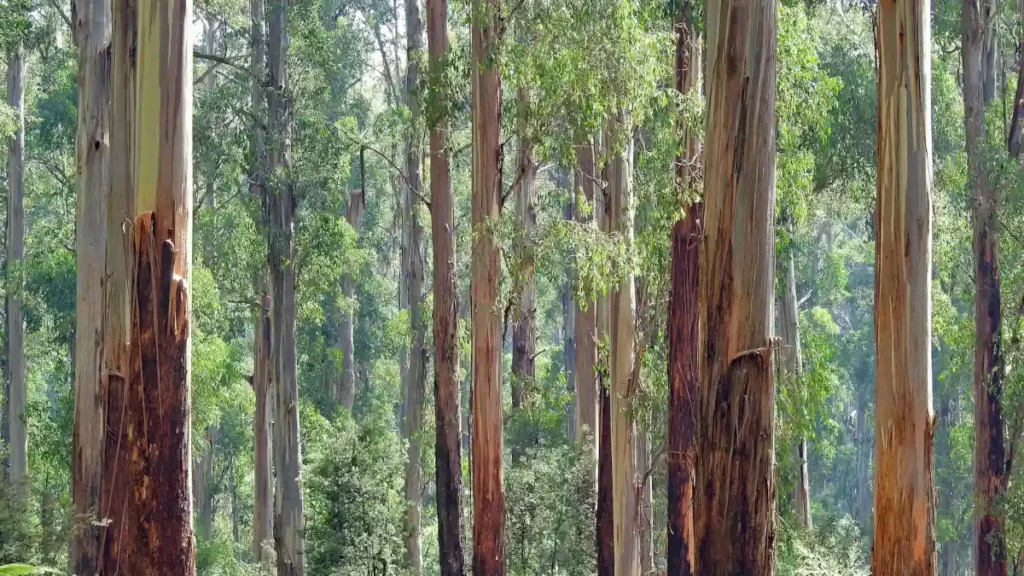
Eucalyptus trees grow fast, smell great and give quick shade, but they can also become some of the tallest, messiest and most hazardous trees in a yard. Big eucalyptus can drop heavy limbs without warning, their bark and leaves burn easily, and cut stumps often sprout back.
This guide explains what to know before you plant, keep or remove a eucalyptus tree, and what eucalyptus tree removal costs in 2026.
What Is a Eucalyptus Tree?
Eucalyptus is a large group of evergreen trees from Australia. California State Parks says settlers first planted eucalyptus in California in the late 1800s, “believing the trees to be a good source of hardwood.” More than 250 species have been planted there, and 18 now reproduce on their own.
The most common large species in the U.S. is the Tasmanian blue gum (Eucalyptus globulus). The California Invasive Plant Council (Cal-IPC) says mature blue gums “can reach 150 to 180 ft tall and 4 to 7 ft in diameter.” It was brought to the U.S. in the early 1850s as an ornamental.
How to recognize one:
- Long, narrow, leathery leaves with a strong menthol smell when crushed.
- Bark that peels off in long strips, often leaving a smooth, patchy trunk.
- Very fast upward growth, often far taller than nearby trees.
HomeGuide lists typical eucalyptus heights of 40 to 180 feet, depending on the species.
Eucalyptus Fire Risk
California State Parks explains that eucalyptus oil is “highly incendiary.” Fire can climb low branches and race up the long strips of loose bark into the canopy, and burning debris can be carried far away. Cal-IPC adds that groves are highly combustible because of flammable oils, dense fine branches and leaf litter, and that “leaves and branches decompose very slowly,” so fuel builds up on the ground.
If you live in a wildfire-prone area:
- Keep eucalyptus well away from the house and trim branches away from roofs.
- Rake up bark strips and leaf litter regularly.
- Check your local fire-safe or defensible-space rules before planting or keeping large trees.
Sudden Limb Drop
Eucalyptus is one of the trees known for dropping large branches on still, hot days. UC Agriculture and Natural Resources says summer branch drop affects “commonly affected tree species such as eucalyptus, elm, and ash,” and “often occurs in the afternoon on hot, calm days.” The cause is not fully understood.
California State Parks also warns that end-heavy eucalyptus branches can fail suddenly from great heights, and that shallow roots can let whole trees topple. UC ANR’s advice: “do not park cars or place play structures, benches, or picnic tables beneath older, susceptible trees.” If limbs have already fallen near a house, see our guide to emergency tree removal.
Eucalyptus Roots and Stumps
Eucalyptus does not die easily. Cal-IPC notes that “trees can resprout from the base when cut or damaged,” so a cut stump often sends up a ring of new shoots. Options:
- Grind the stump below ground and remove the shoots that come back.
- Treat the fresh cut surface with a labeled herbicide. Cal-IPC describes cut-stump treatments with triclopyr, glyphosate or imazapyr applied right after cutting, and notes follow-up is usually needed. Always follow the product label.
- Cut the sprouts repeatedly. Cal-IPC says cutting regrowth when shoots reach 6 to 7 feet, for four years or more, can eventually kill the tree.
See how to kill a tree stump and the stump removal cost calculator.
Do You Need a Permit?
Possibly. Many cities protect large trees regardless of species, while some fire-prone communities encourage removing eucalyptus. Check with your city before cutting; see do I need a permit to cut down a tree.
How Much Does Eucalyptus Tree Removal Cost?
HomeGuide puts the average cost to remove a eucalyptus at $500 to $3,800, one of the higher species ranges, because of the trees’ height. By height, Lawn Love’s 2026 figures are:
| Eucalyptus tree size | Typical removal cost (2026) |
|---|---|
| Up to 30 ft | $285 – $435 |
| 30–60 ft | $435 – $870 |
| 60–80 ft | $870 – $1,160 |
| Over 80 ft | $1,160 – $2,000+ |
| Stump removal (added cost) | $180 – $525 |
National averages; very tall blue gums near buildings can cost far more, toward the top of HomeGuide’s range.
What drives eucalyptus prices higher:
- Height. Trees over 100 feet need climbing crews, rigging and sometimes a crane; see crane tree removal cost and large tree removal cost.
- Heavy, dense wood and lots of debris. Bark strips and leaves add to cleanup and hauling.
- Power lines and buildings. See tree removal near power lines.
- Stump regrowth. Budget for grinding or stump treatment so the tree doesn’t come back.
Measure the tree with the tree height calculator, then get a quick figure from the tree removal cost calculator or compare species with the cost by size and type calculator. Get several written quotes; our tree removal estimate guide shows what to check.
Frequently Asked Questions
Are eucalyptus trees dangerous?
Large eucalyptus can be. They can drop heavy limbs on hot, calm days, their shallow roots can let trees topple, and their oily bark and leaves burn easily. Keep people, cars and play areas out from under big trees.
How tall do eucalyptus trees get?
It depends on the species. HomeGuide lists 40 to 180 feet, and Cal-IPC says Tasmanian blue gum can reach 150 to 180 feet.
Will a eucalyptus grow back after cutting it down?
Often, yes. Cal-IPC says eucalyptus can resprout from the base when cut. Grind the stump or treat the fresh cut with a labeled herbicide, and remove new shoots.
How much does it cost to remove a eucalyptus tree?
HomeGuide puts the average at $500 to $3,800. Very tall trees, difficult access and stump work push the price up.
Why do eucalyptus trees drop branches?
UC ANR says summer branch drop happens on hot, still afternoons, and no single cause is accepted. Old wounds and decay explain only some failures.
Sources: California Invasive Plant Council, Eucalyptus (Tasmanian Blue Gum) Management · California State Parks, Eucalyptus fact sheet · UC Agriculture and Natural Resources, Summer Branch Drop · HomeGuide, Tree Removal Cost · Lawn Love, How Much Does Tree Removal Cost? (2026)
Last updated: November 20, 2026.